
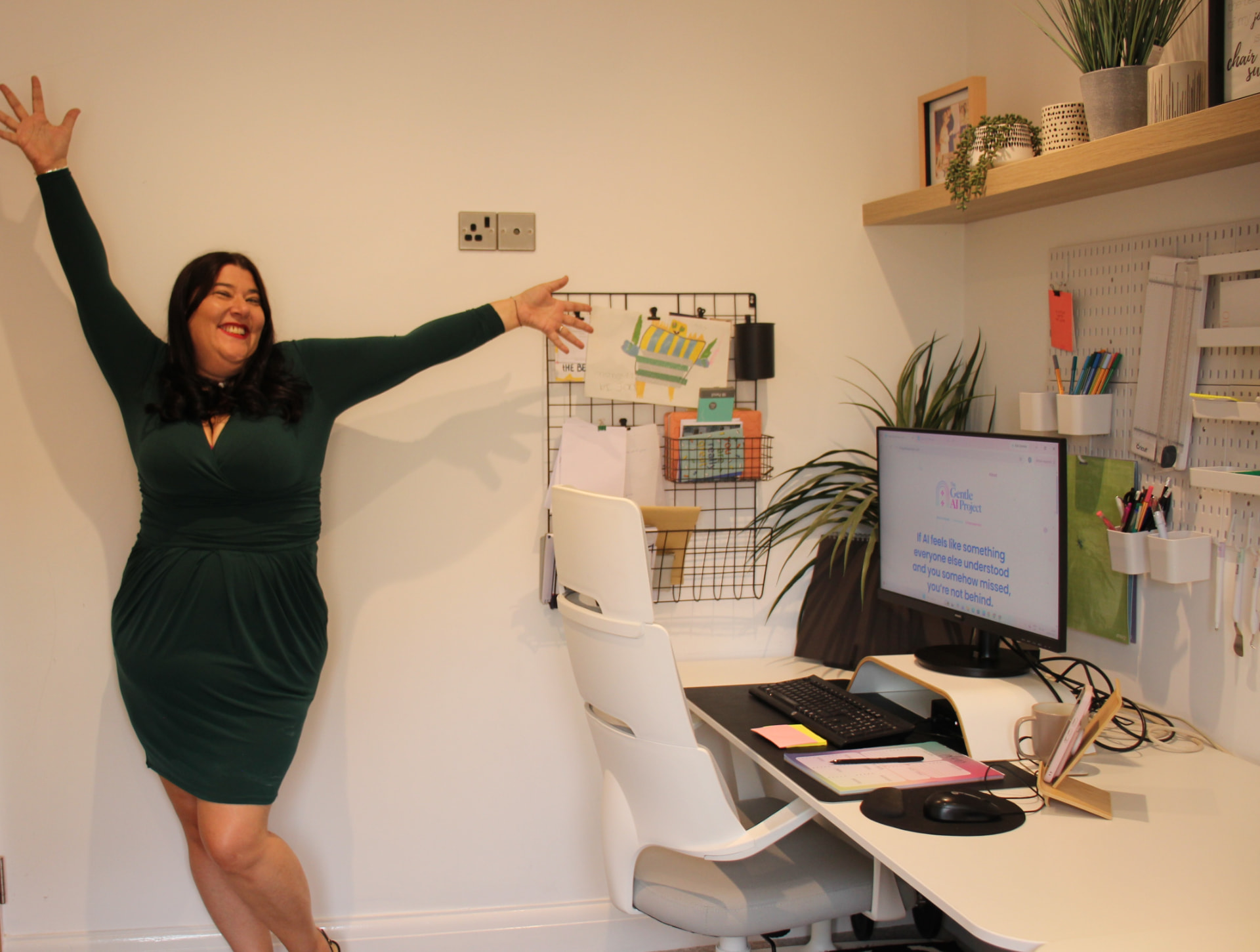
There’s a particular kind of tiredness that I think a lot of midlife women will recognise. You finally sit down, and that’s when your brain starts helpfully reminding you of everything you haven’t done. The email you haven’t replied to. The birthday present you meant to buy. Something your mum needs sorting. What everyone is eating tomorrow. The friend you genuinely meant to message three days ago.
And somewhere in amongst all of that, we are now being told that we should probably get to grips with AI.
Which sounds, initially, like one more bloody thing.
But the more I use it, the more I wonder whether we have this the wrong way round.
AI can’t remove the caring, relationships or responsibilities that create mental load. But it can help with some of the thinking around them: sorting information, turning a brain-dump into a plan, comparing options, drafting messages, working out what to cook and helping you get decisions out of your head.
For women already carrying a lot of invisible thinking, that can be surprisingly useful.
I don’t think midlife women are the people least suited to AI. I think we might be among the people with the most to gain from it.
What do I mean by mental load?
When I talk about mental load, I mean the work of remembering, noticing, anticipating and coordinating the things that keep ordinary life moving.
It’s not necessarily doing the task itself. It’s knowing the task exists.
Who notices the school uniform is getting too small? Who knows when sports day is? Who remembers World Book Day, sorts the birthday present, contributes to the teacher collection, notices somebody hasn’t replied to a message and wonders whether they’re OK?
Outside motherhood, it can look remarkably similar. Who remembers that Dad has a hospital appointment on Thursday while also trying to make a nine o’clock meeting? Who notices the prescription needs collecting, the washing machine is making a strange noise, the work deadline has moved, and there is still absolutely nothing in the house for dinner?
Who keeps a spare bottle of wine in the cupboard because at some point the school will inevitably announce another bloody tombola?
None of this looks like a job.
But somebody still has to think of it.
For some women, that invisible thinking includes children and ageing parents. For others it is work, health, a household, a business, relationships, community commitments, or simply being the person who quietly notices what needs doing and keeps things moving.
My own examples naturally come from motherhood because that is the life I have lived. But mental load does not belong only to mothers.
Why mental load can feel especially heavy in midlife
I grew up in a generation of women who were told we could have it all. We could go to university, build careers, be financially independent, have children and make choices our mothers and grandmothers did not always have.
That mattered enormously.
What didn’t always change at quite the same speed were the expectations around who notices, remembers and manages everything else.
When my children were younger, if my husband took them to school, there was sometimes an element of, “Oh, isn’t he a good dad?” Nobody congratulated me for taking them to school. That was simply what I was supposed to do.
And for many women, midlife adds caring in more than one direction.
We often use the phrase “sandwich generation” for people supporting both younger and older generations at the same time — perhaps children who still need them and parents who increasingly do too.
Although “sandwich” has always struck me as a suspiciously tidy word for it.
Two neat slices of bread, everything contained in the middle. Lovely.
Some days it feels more like somebody has tipped the entire contents of the fridge onto your lap — last night’s lasagne, the leaking yoghurt, the half cucumber nobody remembers buying — and said, “Can you just hold that for a minute?”
There is real evidence behind the sense that caring lands heavily on women in this stage of life. In England’s 2021 Census, 10.3% of women were providing unpaid care compared with 7.6% of men. The highest rate for women was among those aged 55–59, where 19.9% — roughly one in five — were providing unpaid care. The Office for National Statistics reports the figures directly, and Carers UK independently highlights the same pattern. [1][2]
My children are older now, but if college has an issue, they still phone me first rather than my husband.
The nature of the work changes. It doesn’t necessarily disappear.
I was always the organised one
This is one reason I’m wary when overwhelm gets treated as an organisation problem.
I have always been seen as very organised. I’m an ex-teacher; I love stationery, planners and a decent pen. Every summer I used to print eight weeks of planners, colour-code what everyone was doing and stick the whole thing on the door.
People would look at it and say, “Oh my God, you’re so organised.”
They were right.
I was excellent at the big things and the routines. Back to school was sorted. Uniform was labelled. I even found a permanent-ink clothing stamp because there was absolutely no way I was going to spend hours ironing labels into clothes if the whole problem could be solved in about two minutes.
That kind of problem-solving genuinely gives me pleasure.
See problem, find workaround, move on.
What I was much worse at were the loose ends: the music lesson that changed, the form that appeared out of nowhere, the thing that happened irregularly enough not to become part of a system.
Library books were my nemesis. We eventually stopped using our local library, not because I don’t think libraries are wonderful, but because I repeatedly forgot to return the books and got fined.
There is something surprisingly uncomfortable about being “the capable one” and still dropping things.
You start wondering what is wrong with you.
I’m organised. I have systems. Why can’t I manage this?
Midlife has made that question harder at times. My periods have never exactly been a minor inconvenience, and perimenopause has added its own particular chaos. There are days when the brain I have relied upon for years to hold fifteen moving parts simply doesn’t behave in quite the same way.
That can hit your sense of competence more than people realise.
CIPD research found that around one in six people experiencing menopause symptoms had considered leaving work because they lacked support. The same 17% figure is also cited in the UK Government’s menopause employment progress report. [3][4]
I don’t think the answer to any of this is telling women to become better organised.
Quite a lot of us are already astonishingly organised.
We have had to be.
Mental load isn’t only admin
The other part of mental load that doesn’t fit neatly on a to-do list is the emotional work.
I care a lot about people, and I genuinely like doing thoughtful things. I’ll make soup for someone who is ill, drop off a card, or buy something months before somebody’s birthday because I happened to see it and knew it was perfect for them.
For years I had a present box under my bed. I stocked it throughout the year and bought cards and wrapping paper in the January sales, because apparently one of my personality traits is being thrilled by half-price Christmas cards on 3 January.
I enjoyed a lot of that.
I don’t want to rewrite my own life as though every act of care was unpaid drudgery reluctantly forced upon me.
But voluntary doesn’t mean weightless.
There were plenty of times when somebody I loved would suddenly pop into my head and I would think, “Oh God, I meant to message her,” followed very quickly by guilt.
There have also been periods of my life where I have spent a huge amount of energy noticing what everyone else needs and monitoring the emotional temperature around me.
That effort is real even when nobody else can see it.
Women are often expected not just to care, but to operationalise care.
Remember the appointment. Buy the card. Arrange the collection. Check afterwards. Make sure the right person knows. Notice what has been forgotten.
And I think this distinction matters enormously when we start talking about AI, because I don’t want AI doing the caring.
I want it helping with some of the machinery around it.
A kitchen taught me a lot about invisible work
One of my many jobs was demonstrating kitchen appliances in people’s homes.
It meant I spent a lot of time sitting in family kitchens talking to people about how they actually fed themselves.
I began noticing a difference in the way men and women often talked about cooking. Obviously this wasn’t universal, but men who told me they loved cooking were often describing cooking as an activity: trying an elaborate recipe, spending an afternoon making something interesting, cooking for pleasure.
Women were much more likely to talk about feeding people.
Those are not quite the same job.
Feeding a family involves knowing what is in the fridge and freezer, what is about to go off, what people currently will or won’t eat, what needs defrosting, what was on offer, whether someone has football at six, whether leftovers need using and whether there is enough milk for breakfast.
Then you get to cook the dinner.
One woman I demonstrated for has always stuck in my mind. She told me she was simply exhausted by deciding what to cook. Every week she bought a rotisserie chicken and a bag of salad.
Her family were bored with it. She knew they were bored with it.
But she simply couldn’t face thinking of another meal yet again.
What she loved about the appliance wasn’t merely that it physically cooked things.
It gave her ideas.
It removed some of the thinking.
That is exactly the sort of thing that makes me interested in AI now.

How can AI help reduce mental load?
Not by taking over your life.
And not by asking you to become the sort of person who wants to spend Sunday afternoon “optimising workflows”.
I mean ordinary things.
You can stand in front of the fridge and say:
“I’ve got chicken, half a bag of spinach, three peppers that need using, some yoghurt and feta. I’ve got about half an hour tonight. What could I make, and what would I need to add to the shopping list?”
On the surface, that is one decision: what’s for dinner?
Except it’s sneaky.
Hiding inside that one question are meal planning, food waste, time, what needs using first, what you already own, what you need to buy and whether dinner can actually be on the table before everyone starts eating cereal in protest.
That is not an earth-shattering use of artificial intelligence.
It is dinner.
But if AI can take even some of that thinking off my plate — quite literally in this case — I’m interested.
The same principle can help with other bits of everyday mental load:
- turn a rambling brain-dump into a usable plan;
- pull actions and dates out of several emails;
- compare options when you are too tired to hold all the pros and cons in your head;
- draft a message you have been putting off;
- help plan meals around what you already have;
- turn a messy list of “things I must remember” into something you can actually use.
I am not suggesting handing over every school or college email containing personal information without thinking about privacy first. The tool matters, the settings matter, and sensitive information needs care.
But the underlying idea is simple:
some of the thoughts currently living in your head do not need to stay there.
Perhaps we are not bad at technology after all
This is the part that makes me genuinely excited, because I think there is still an assumption that AI naturally belongs to technical people, younger people or people who happen to work somewhere that is already talking about it.
I don’t buy that.
Women my age remember landlines, life before Google and probably life before having a computer at home.
Since then we have learned email, online banking, smartphones, WhatsApp, satnav, digital calendars, school portals and an obscene number of passwords.
We did not grow up digital.
We became digital.
Again and again, we adapted.
So when a woman tells me that she is “not technical”, I don’t necessarily hear somebody who is incapable of learning AI.
I often hear somebody who has never been shown a reason to care about it.
Some people are encountering AI through work because their industry, employer or colleagues are already using it.
Plenty of others are not.
That has nothing to do with how intelligent or capable they are; it simply means nobody has yet shown them a version that relates to their actual life.
That is the version I care about.
Not “generate a report”.
Not “automate your sales funnel”.
More like:
“You know all those small decisions that are eating your brain? Some of them don’t have to stay in your brain.”
Why women need to be part of the AI conversation
Caroline Criado Perez’s Invisible Women had a profound effect on me because it gave me language for something I had noticed without fully understanding.
The book explores the gender data gap: the way systems, policy, research, technology and design can be built around male experience as the default, with real consequences for women. That description is central both to Criado Perez’s own account of the book and to its publisher’s summary. [5][6]
Once you see that pattern, it becomes harder to assume that every woman struggling inside a system simply needs to try harder.
Sometimes the system genuinely does not fit particularly well.
That matters when we talk about AI too.
If the examples, language and teaching are aimed primarily at people already comfortable with technology, we shouldn’t be surprised if other people conclude that the technology is not meant for them.
And if women step away from AI because the first examples they see are all coding assistants, corporate productivity or people shouting about “10x output”, we lose more than an opportunity to save twenty minutes on dinner planning.
We risk another important technology being shaped without enough of the people whose lives it is going to affect.
This is the gap I care about
I don’t want AI to replace caring, judgement, friendship, creativity or thought.
I don’t want a machine deciding who I should love or what matters to me.
I want it to help with some of the scaffolding around those things.
I want to be able to ramble into my phone about everything I need to remember and have it turned into something I can use.
I want help comparing three options when my brain is too tired to hold all of them at once.
I want to be able to take a pile of non-sensitive information and work out what actually needs doing.
I want somewhere to put the thought so I don’t have to keep carrying it.
And I want women to know that this is part of what AI can be for.
The name of my business is The Gentle AI Project — GAP — and while I chose it before I had fully articulated this idea, I now think the name fits better than I realised.
There is a gap between some of the people carrying the greatest invisible mental load and the people currently being shown what AI can do.
There is a gap between the extraordinary technical capability of these tools and the wonderfully ordinary ways they can make daily life easier.
There is a gap between hearing “artificial intelligence” and standing in your kitchen asking what on earth you can make with three peppers and a slightly sad bag of spinach.
That is the gap I want to work in.
If this sounds like the kind of AI you would actually like to learn about — practical, calm and useful in ordinary life rather than another demand to become more productive — you can sign up to my newsletter. I share simple ideas, prompts and real-life examples to help you work out what AI might genuinely take off your plate.
I don’t want AI to help women do more.
I want it to help us carry less.
Frequently asked questions
What is mental load?
Mental load is the thinking behind everyday life: remembering, noticing, anticipating, planning and coordinating what needs to happen. The visible task might be buying a birthday present; the mental load includes remembering the birthday, choosing the present, ordering it in time and knowing who still needs a card.
Why can mental load feel heavier in midlife?
Midlife can bring several demands together at once: work, household admin, relationships, health changes, children who still need support and ageing parents who may need more. Not every woman has the same responsibilities, but this life stage can involve carrying several different kinds of practical and emotional thinking at the same time.
How can AI help with mental load?
AI can help with some of the scaffolding: organising a brain-dump, summarising non-sensitive information, generating meal ideas, comparing choices, drafting messages and turning messy thoughts into a plan. It does not remove responsibility or replace judgement, but it can reduce some of the repetitive thinking around everyday tasks.
Do I need to be technical to use AI in everyday life?
No. You do not need to code or understand how an AI model works internally to use a tool such as ChatGPT for ordinary tasks. What matters more is learning how to explain what you need, refine the answer, check important information and understand what you should not share.
Is it safe to put personal information into AI?
It depends on the tool, its settings and the information involved, so “just paste everything in” is not a good rule. Avoid sharing sensitive personal, health, financial, confidential or identifying information unless you understand how that service handles it. For important decisions, check the output rather than treating AI as an authority.
A gentle AI reminder
AI can be brilliantly useful, but it can also be confidently wrong.
Check anything important, think carefully before sharing sensitive personal information, and keep your own judgement in the driving seat — especially when it comes to health, money, work or anything else that really matters.
References / Sources
- Office for National Statistics, Unpaid care by age, sex and deprivation, England and Wales: Census 2021.
- Carers UK, Key facts and figures / Census 2021 findings on unpaid care.
- CIPD, The menopause at work: guidance for people managers, 2026.
- UK Government, Shattering the Silence about Menopause: 12-Month Progress Report.
- Caroline Criado Perez, Invisible Women — author’s description of the book and gender data gap.
- Penguin / Vintage, Invisible Women: Exposing Data Bias in a World Designed for Men.